
 01243 776938
 info@jamestoddandco.co.uk
Imagine your management team tells you that a major project has already cost millions of pounds and is unlikely ever to recover its investment.
Do you stop now, or continue in the hope that things will improve?
From a purely financial perspective, the answer seems straightforward. The money has already been spent and can’t be recovered, so the only sensible question is whether continuing to invest will create a better outcome.
History suggests the decision isn’t always so simple.
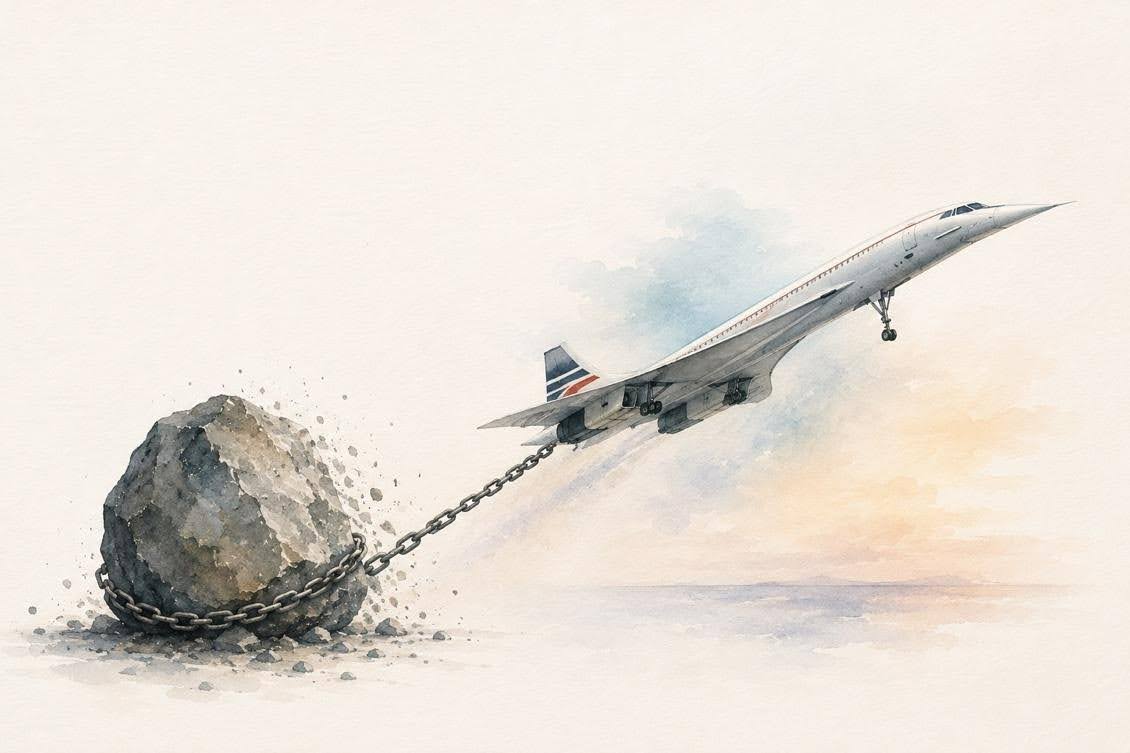
During the development of Concorde, Britain and France continued investing in one of the most ambitious engineering projects ever undertaken, despite growing evidence that the programme would never become commercially viable. Concorde became an icon of engineering excellence and transformed air travel, but commercially it never justified the enormous investment. The project became so closely associated with continuing to invest after the economic case had weakened that economists coined a term for this behaviour: the Concorde Fallacy.
When Yesterday Influences Tomorrow
The Concorde Fallacy describes our tendency to let past investment influence future decisions. Once we’ve committed significant time, money or effort to something, it can become difficult to step back and assess the situation objectively, even when circumstances have changed.
During the 1970s, psychologists Daniel Kahneman and Amos Tversky transformed our understanding of decision-making by showing that people are influenced as much by psychology as by logic. Their work demonstrated that we naturally place greater weight on what we’ve already invested than on what is most likely to create value in the future.

It’s a tendency that affects governments, global organisations and small businesses alike.
The Decisions That Quietly Become Permanent
Few businesses have to decide whether to continue funding a supersonic aircraft, but many face smaller decisions that are surprisingly similar.
Perhaps it’s a software package that no longer fits the business but renews every year. A service that once performed well but now contributes very little. A monthly report that everyone receives but nobody reads. Or a customer relationship that absorbs far more time than it generates in value.
Many long-standing decisions continue to add real value. Others simply haven’t been revisited for some time. The challenge is knowing the difference.
As businesses grow, it’s natural for processes, systems and ways of working to accumulate over time. Rarely does anyone consciously decide to keep them forever; they simply survive because nobody has stopped to ask whether they still serve the business today.
Looking Beyond Sunk Costs
When business owners think about investment, it’s natural to focus on what’s already been spent. Yet that money, time or effort belongs to the past, regardless of what happens next.
The more valuable question is what economists describe as opportunity cost – the value of the alternatives we choose not to pursue.
Every pound tied up in an underperforming product is a pound that can’t be invested elsewhere. Every hour spent maintaining an outdated process is an hour unavailable for customers, innovation or strategic planning. Even a report that nobody reads still takes someone’s time to produce every month.
Continuing to invest in one area inevitably limits the resources available for another. That’s why reviewing existing commitments can be just as important as identifying new opportunities.
Instead of asking, “Can we afford to stop?”, the more useful question is often, “Can we afford to continue?”
Building Review into the Business
This doesn’t mean abandoning every initiative that encounters difficulties. Many successful businesses owe their achievements to persistence, particularly when worthwhile investments take time to deliver results.
The difference is that persistence should be a conscious decision rather than an automatic one.
Some leadership teams now include a regular “stop doing” review alongside their strategic planning. As well as discussing new opportunities, they deliberately revisit existing products, services, systems and processes to decide whether they still deserve the same commitment.
The discussion often starts with a few straightforward questions.
- If we were making this decision for the first time today, would we make the same choice?
- What evidence would persuade us to change our minds?
- Has the business changed since this decision was made?
- Does this still create value, or have we simply stopped questioning it?
These aren’t always easy conversations, but they often lead to better decisions.
The Value of Looking Again
Successful businesses aren’t defined by never changing direction. More often, they’re defined by recognising when circumstances have changed and taking the time to look again.
Markets evolve, technology advances and customer expectations shift. Decisions that made perfect sense five years ago may no longer represent the best use of your time, energy or investment today.
The most resilient businesses don’t just review their financial performance. They also make time to review the decisions that shape it.
How James Todd & Co Can Help
At James Todd & Co, we believe good advice is about more than explaining the numbers. It’s about helping business owners make confident decisions about the future.
By combining financial insight with strategic business advice, we help our clients step back from the day-to-day running of their business, challenge long-standing assumptions and focus their time, money and energy where it will have the greatest impact.
Sometimes the best decision isn’t about what to start.
It’s about recognising what no longer deserves the same investment.
Because sustainable growth isn’t about defending yesterday’s decisions. It’s about making today’s decisions with tomorrow in mind.